


Summary / Key Points
-
A Self-Directed IRA allows retirement funds to be invested in private assets, including professionally managed real estate offerings.
-
The underlying investment does not change. What changes is the funding structure, account titling, and administrative process.
-
When investing through an SDIRA, the IRA, not the individual, is the legal investor. All income and expenses flow through the retirement account.
-
Custodians provide administrative services such as document review, wiring, and record-keeping. They do not evaluate investments or provide return guidance.
-
Leverage inside an IRA may trigger Unrelated Business Income Tax (UBIT). Only the portion of income attributable to debt financing may be subject to tax. Investors should consult qualified tax advisors before investing.
-
Custodian fee structures vary by provider and service model. Modeling setup fees, annual charges, and transaction costs over the expected holding period is important.
-
When investing through Steadfast, our role is limited to providing offering documents, coordinating with the selected custodian, and executing the business plan once funded.
-
Using retirement capital requires understanding the process, tax considerations, liquidity constraints, and administrative responsibilities in advance. Investors should evaluate whether this structure aligns with their broader financial plan before committing IRA funds.
Over the past year, we’ve had more questions from investors about using a Self-Directed IRA (SDIRA) to invest in private real estate.
For many investors, retirement accounts represent a meaningful portion of total investable capital.
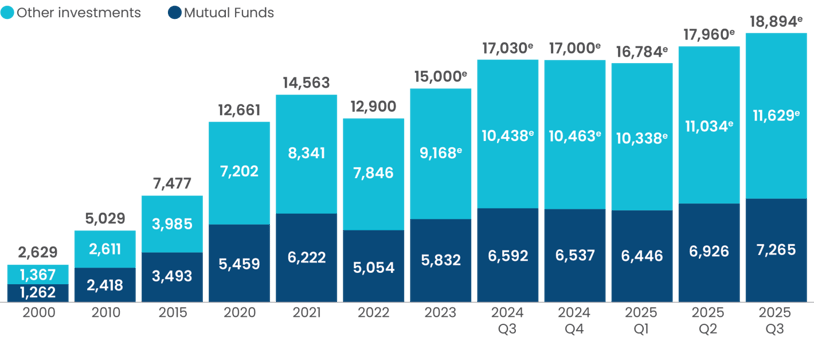
According to the Investment Company Institute, U.S. IRA assets totaled approximately $18.9 trillion as of the third quarter of 2025, representing roughly 40 percent of all U.S. retirement assets nationwide. IRA balances now rival the size of employer-sponsored 401(k) plans combined, underscoring the scale of capital held within individual retirement structures.¹
As shown below in Figure 1, a significant share of IRA assets remains invested in traditional public market vehicles such as mutual funds. In many cases, this allocation reflects default investment settings or long-standing account positioning rather than an intentional review of all permissible options within the IRA structure.
Figure 1: How U.S. IRA Assets Are Allocated Across Investment Types
Source: https://www.ici.org/statistical-report/ret_25_q3
Note: IRA Market Assets, Billions of dollars, end-of-period, selected periods Sources: Investment Company Institute, Federal Reserve Board, American Council of Life Insurers, and Internal Revenue Service Statistics of Income Division
An SDIRA operates within the same retirement framework but allows a broader range of permissible investments, including private assets such as real estate. That flexibility introduces additional responsibilities, administrative steps, and tax considerations that investors should understand before reallocating retirement capital.
This guide explains how SDIRAs work for real estate investing and outlines the key factors investors should evaluate before making that decision.
What Exactly Is a Self-Directed IRA?
An SDIRA is a type of individual retirement account, or IRA, that allows the account holder to invest in a wider range of assets than a standard brokerage IRA, including certain private market investments such as real estate.
It operates under the same basic tax rules that govern traditional and Roth IRAs, including rules around contributions, distributions, and tax treatment. The main difference is not the tax structure, but the range of investments the account can hold. Instead of being maintained at a brokerage that generally limits investments to publicly traded securities, SDIRA is administered by a custodian that supports alternative assets.
A broader investment menu requires a different type of account administration, which is where custodians come in. A custodian is an administrative firm that holds the retirement account, processes required paperwork, facilitates funding, and helps ensure IRS reporting requirements are met. Custodians provide administrative and custodial services, but they do not advise investors on the merits or expected performance of any particular investment.
Why Alternative Investments Are Playing a Larger Role in Retirement Planning
Interest in alternative investments has grown as some investors have looked beyond publicly traded securities for additional sources of diversification, income potential, and longer-term fundamentals.
Recent market conditions have contributed to that shift. In 2025, public market correlations remained elevated relative to historical norms, leading some investors to evaluate asset classes with different return drivers and cash flow characteristics.
How Real Estate Is Commonly Used Inside SDIRAs Today
When real estate is held through an SDIRA, the investment is owned by the IRA rather than by the individual account holder. Funds are sent by the custodian, the investment is titled in the name of the IRA, and all income and expenses flow through the retirement account in accordance with IRS rules.
In practice, many investors use SDIRAs to access professionally managed real estate investments that are structured to remain passive from the investor’s standpoint. This can help preserve the separation between the IRA and the individual account holder that IRS rules require. For many retirement investors, that kind of structure is easier to administer and maintain over time.
Understanding UBIT in Real Estate Investments Held Inside an SDIRA
Unrelated Business Income Tax, or UBIT, is one of the most important and sometimes misunderstood concepts to understand when investing in real estate through an SDIRA.
In most cases, passive income earned inside an IRA remains tax-deferred or tax-free, depending on the account type. UBIT generally becomes relevant when leverage is used. If a real estate investment inside an IRA includes debt, the portion of income attributable to that financed amount may be subject to tax. This is commonly referred to as Unrelated Debt-Financed Income.
UBIT does not apply to the entire investment. It applies only to the percentage associated with debt. For example, if a property is 60 percent financed, only the income attributable to that financed portion may be taxable. The remaining income retains its tax-advantaged status within the IRA.
This does not automatically mean that a leveraged investment is now unattractive. In many cases, projected net returns can remain compelling even after accounting for potential UBIT. What matters is understanding how leverage affects after-tax outcomes before you invest.
When investors evaluate an opportunity with Steadfast, we provide clear information on capital structure and projected returns so that potential tax considerations can be reviewed in advance. Because UBIT treatment can vary based on financing levels and individual tax circumstances, investors may choose to review the structure with their qualified tax professional to ensure it aligns with their broader financial plan.
Choosing a Self-Directed IRA Custodian and Understanding Fees
Fee models for custodians vary meaningfully by provider and service design. Some custodians charge per transaction. Others charge subscription-style annual fees. Some offer checkbook-control structures that shift more responsibility to the account holder.
Understanding how fees are charged, and how they scale over time, is an important part of selecting a custodian.
Below (in Figure 2) is a high-level comparison, presented in alphabetical order, of selected SDIRA custodians and their published fee structures. Availability for a specific investment may depend on the custodian’s internal review process and any sponsor onboarding requirements.
This comparison is intended as a starting point for evaluation. Investors should review each provider’s current fee schedule and service terms directly before making a decision, as fees are representative and subject to change.
1. Alto IRA
Alto IRA represents a newer generation of SDIRA platforms focused on simplicity and digital onboarding. Alto typically uses a subscription-style pricing model with flat annual fees and limited transaction charges for standard activity.
For investors allocating capital to passive alternative investments such as real estate syndications, this approach can offer cost predictability over time.
2. American Estate & Trust (AET)
American Estate & Trust is an SDIRA custodian that supports alternative investments such as private real estate. Their fee structure generally includes account setup fees, annual custodial charges, and administrative fees associated with processing investment transactions.
This type of structure may appeal to investors seeking a traditional custodian with straightforward annual administration fees.
3. Equity Trust
Equity Trust is one of the largest and longest-operating SDIRA custodians in the United States. They typically use a transaction-based fee model, with account setup fees, annual custodial fees, and additional charges for purchases, income processing, and administrative actions.
For investors making a small number of long-term investments with limited activity, this structure can be economical. Investors expecting frequent transactions should review how per-transaction fees may accumulate over time.
4. Rocket Dollar
Rocket Dollar enables checkbook-control structures through an IRA-owned LLC. Fees are generally front-loaded, with setup costs and ongoing membership fees, while per-transaction custodian fees are reduced.
This structure offers flexibility and speed, but it places greater responsibility on the investor for compliance, record-keeping, and proper administration.
5. The Entrust Group
The Entrust Group is another established custodian with a strong emphasis on education and process support. Its fees are generally transaction- and asset-based, similar to other traditional custodians.
This model may appeal to investors who value structured administrative support and are comfortable with fees scaling alongside account activity.
Figure 2: SDIRA Custodian Fee Comparison
| Setup Fee | Ongoing Annual / Subscription Fee | Transaction Fees | May Be Suitable For |
| Alto IRA | |||
| $0 | ~$120–$300 annually (subscription-based) | Limited or none for standard activity | Passive alternative investments and syndications |
| American Estate Trust (AET) | |||
| $50 | ~$349.95 (annual account fee) | Yes (asset purchases, wires, administrative processing) | Investors seeking a traditional custodian with straightforward annual administration fees |
| Equity Trust | |||
| ~$50–$100 | ~$225–$2,400 (tiered by account value) | Yes (asset purchases, income, expenses, changes) | Long-term investors with limited transactions |
| Rocket Dollar | |||
| ~$360–$600 | ~$180–$360 annually | No per-transaction custodian fees | Experienced investors seeking checkbook control |
| The Entrust Group | |||
| ~$50–$100 | ~$199–$2,000+ (asset-based tiers) | Yes (transaction and service-based) | Investors who value education and traditional custodial support |
Source: Respective SDIRA custodian websites; compiled by Steadfast Companies, 2026. Fee ranges shown are representative and may vary by account type, service tier, or promotional pricing.
There is no single SDIRA provider that has the lowest cost in every situation. The appropriate choice depends on how the account will be used, how often transactions will occur, and how much administrative responsibility the investor is willing to assume.
If the account will hold one or two long-term investments with minimal activity, a transaction-based custodian may be economical. Fees are incurred as actions occur, so limited transactions often mean limited cost.
By contrast, subscription-based platforms charge flat annual fees. For investors allocating to passive investments with few expected changes, this structure can offer predictability and simplify cost planning.
Some providers also offer checkbook-control structures. These arrangements may reduce per-transaction custodian fees and provide greater flexibility. However, that flexibility comes with added responsibility. The investor assumes more direct oversight, including legal formation, accounting, and compliance requirements.
Because all SDIRA fees are paid directly from retirement assets, cost differences compound over time. Modeling expected fees over the anticipated holding period helps investors understand the long-term impact before selecting a provider.
How to Invest with a Self-Directed IRA Through Steadfast Direct
For investors using an SDIRA, the process generally begins with establishing and funding the account, followed by completing the offering and custodian documentation needed to make the investment through that retirement structure.
Step 1: Establish and fund the SDIRA
The investor first opens and funds an SDIRA with their chosen custodian or IRA provider.
Step 2: Review the offering and complete subscription documents
Once the account is in place, Steadfast provides the required subscription documents. These materials are completed in the name of the IRA rather than the individual investor.
Step 3: Submit any custodian-required paperwork
The exact process then depends on the custodian and account structure. Some providers require additional authorization forms, while others may require custodian-specific paperwork or sponsor onboarding materials as part of their review.
Step 4: Funding is processed through the IRA structure
Once the required documentation is complete, funds are sent through the IRA structure in accordance with the custodian’s process.
Step 5: The investment is held for the benefit of the IRA
The investment is recorded in the name of the IRA, and any distributions flow back to the IRA structure rather than to the investor personally.
For example, certain custodians such as Equity Trust may require sponsor-submitted onboarding documentation in addition to executed subscription materials. American Estate & Trust (AET) may also require custodian-specific onboarding steps. For the Estraya Boerne offering on Steadfast Direct, the AET process included submitting an application, executing a service agreement following legal review, and providing offering documentation such as the Private Placement Memorandum (PPM), Operating Agreement, and Estraya Boerne subscription materials. Exact forms, review procedures and timelines vary by provider.
Steadfast’s role in this process is limited to providing offering documents, coordinating with the selected custodian or IRA provider as needed, and confirming subscription details. We do not establish, manage, or advise on retirement accounts. The investment thesis and execution remain the same regardless of whether capital is invested through a taxable account or a retirement structure.
When a Self-Directed IRA May or May Not Make Sense
Using an SDIRA to invest in private real estate may be appropriate for investors who:
-
Have a long-term time horizon
-
Do not require near-term liquidity
-
Understand the administrative structure
-
Are comfortable reviewing tax implications with a qualified advisor
It may be less appropriate for investors who anticipate short-term access needs, prefer simplified brokerage-based retirement accounts, or are unwilling to manage additional administrative steps. Remember, structure should align with the investor’s broader financial plan, risk tolerance, and liquidity needs.
To gain more insights, please read more resources here.
Disclaimer: The information provided in this article is for informational and educational purposes only and should not be construed as investment, tax, or legal advice. Nothing herein constitutes an offer to sell or a solicitation of an offer to buy any security. Private real estate investments involve substantial risks, including the possible loss of principal, and are generally intended for accredited investors who understand and can bear those risks. Any discussion of tax treatment relates to general structural considerations and does not reflect individual investor outcomes. Tax consequences vary based on personal circumstances. Readers should consult their own financial, legal, and tax advisors before making any investment decision.
Sources/Footnotes:
More Market Insights



Every investor’s journey is different. Our team is here to listen, answer your questions, and provide perspective based on decades of multifamily experience.
