
Apartment Investing in 2027: Five Questions on Every Investor's Mind

Steadfast Companies
After four years of weak apartment rent growth, investors have good reason to question repeated predictions of a recovery. As we approach 2027, what has actually changed, where are the opportunities, and what are the risks?
We reviewed ULI and PwC's Emerging Trends in Real Estate 2027 report alongside CoStar's latest market data and our own experience at Steadfast. Here are five questions we believe deserve investors' attention.
1. If Construction Is Slowing, Why Aren't Rents Recovering Faster?
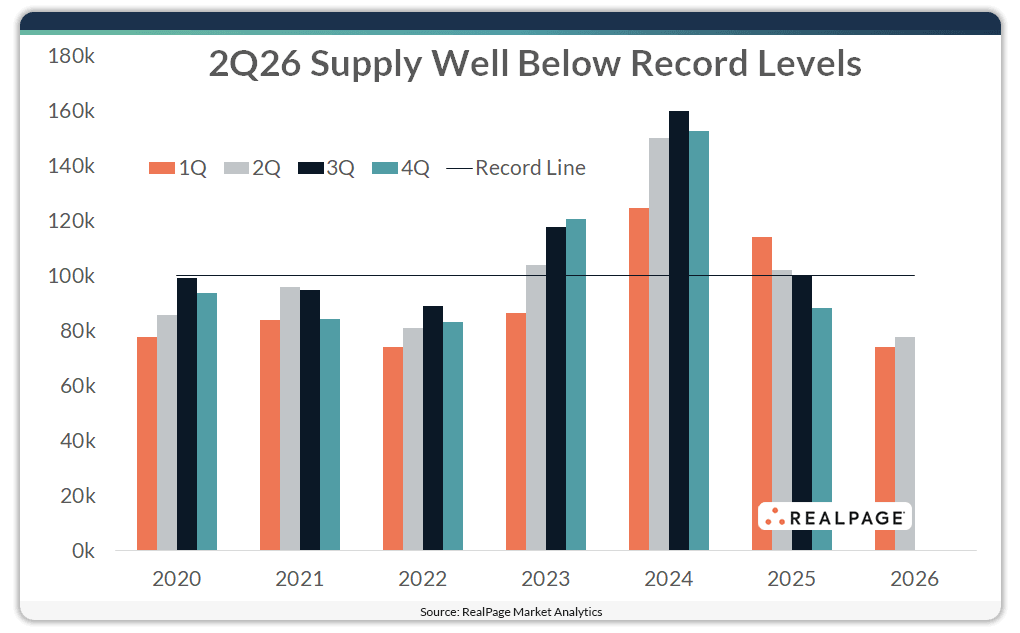
The good news is that apartment demand has finally overtaken new construction nationally. Over the past year, renters filled approximately 502,000 apartments while developers completed 434,000, according to CoStar's November 2026 report.
Yet rents, after accounting for discounts and free-rent offers, have grown just 0.6% nationally.
The reason? According to Yardi Matrix data cited by ULI, more than 1 million apartments were in newly built communities still working to fill their units in September 2026. In markets with too many apartments available, landlords are offering free rent or lowering prices to attract tenants. This competition is keeping rents low, even as construction slows.
Even forecasts disagree on how quickly construction will slow. RealPage expects approximately 300,000 new apartments in 2027, while Yardi Matrix projects deliveries to fall to around 450,000 by 2028.
What matters in 2027 ➡️ The next sign of meaningful recovery will be landlords filling apartments without offering discounts and successfully raising rents. Until then, improving occupancy may translate into only modest income growth.
2. Will 2027 Be the Year Apartment Rents Finally Recover?
ULI's outlook suggests 2027 could bring a return to modest rent growth if apartment demand remains strong and construction continues to slow. However, researchers disagree about how quickly that improvement will reach individual markets.
Consider Dallas-Fort Worth and Nashville. Both rank among ULI's top markets for overall real estate prospects, yet CoStar reports apartment rents falling 2.3% annually in each. Meanwhile, markets with less recent construction, including Chicago and parts of the Midwest and Northeast, have seen steadier rent growth.
There is also a risk that deserves more attention. What happens if renter demand weakens just as construction slows? ULI points to slower hiring and population growth as potential obstacles. Fewer new apartments will help, but owners still need enough qualified renters to fill them.
Higher rents don't always mean higher profits. Property taxes, insurance, payroll, maintenance, and financing expenses all affect how much income remains after operating and financing costs.
For example, a property collecting 3% more rent but spending substantially more on insurance and repairs may see little improvement in its overall financial position.
Our perspective ➡️ We see potential for gradual improvement in 2027, with considerable differences between markets. At Steadfast, we're watching whether properties can increase the rent they actually collect while keeping expenses under control. Ultimately, stronger property income matters more than an encouraging headline about national rent growth.
3. Where Will the Investment Opportunities Come From in 2027?
After several challenging years for apartment investing, could 2027 offer a better time to invest?
Apartment prices have fallen from their previous highs, and some owners are under pressure to sell as their loans come due. This could create opportunities for experienced buyers like Steadfast to acquire established apartment communities at more reasonable prices.
But there's a catch. As Steadfast CIO Bill Stoll has emphasized, many deals still don't work financially. A property may be cheaper than it was three years ago, yet its rental income may still be too low to justify the purchase price and borrowing costs.
So, what opportunities will we look for in 2027? Our strategy, outlined in our investment thesis, remains largely unchanged and, no pun intended, it remains steadfast.
We'll continue pursuing selective, measured acquisitions of well-located suburban apartment communities with existing rental income and opportunities for modest improvements. We're particularly interested in attainable housing for working households, in neighborhoods where demand is healthy and new construction is manageable. With rent growth still uncertain, we'll favor properties that make financial sense today, without relying on aggressive rent increases or costly renovations to justify the investment.
Our investment process will remain equally disciplined. Steadfast typically acquires properties using its own capital, begins improving and stabilizing operations, and arranges long-term, fixed-rate financing before inviting Steadfast Direct investors to participate. This allows us to address initial operational challenges and gives investors the opportunity to evaluate an actual operating property, with more of the upfront work already completed.
Our view ➡️ We expect 2027 to present opportunities worth pursuing, but we're prepared to pass on properties that don't meet our standards. We may carefully select apartment investments at sensible prices, supported by existing rental income and a realistic plan for improvement.
4. What Type Of Apartments Will Be Better Positioned?
Housing affordability remains one of the strongest arguments for apartments serving working households.
ULI's 2027 survey found greater investor interest in lower-income multifamily than higher-income apartments, with 52.5% of respondents recommending buying the former, compared with 45.2% for the latter.
But the report also raises an important concern. Housing shortages don't automatically translate into demand at every rental price.
When rents become unaffordable, some people move in with family, share apartments, or delay forming their own households.
That makes the relationship between local wages and apartment rents particularly important.
At Steadfast, our focus is on attainable apartments in established suburban communities, serving households that need quality housing at a reasonable cost.
What matters in 2027 ➡️ We believe properties offering a good balance of quality, location, and affordability deserve close attention. We will consider whether rents are sustainable for local households and whether future increases can be supported by actual wage growth.
5. What Should Investors Be Most Careful About in 2027?
One of the biggest mistakes would be assuming that an improving apartment market automatically makes every investment attractive.
A property could be well occupied and still struggle financially if its expenses are too high or its loan payments consume too much of its income.
Likewise, an apartment community might appear inexpensive compared with its 2022 valuation, but still be overpriced based on what it earns today.
These are important distinctions for anyone evaluating private apartment investments.
At Steadfast, our investment approach emphasizes existing cash flow, manageable property improvements, and fixed-rate financing with moderate borrowing levels. We want properties that can support their financial obligations based on realistic assumptions.
We're also preparing 2027 operating budgets, reviewing expenses, managing financing decisions, and evaluating potential property sales across our existing portfolio.
What matters in 2027 ➡️ Investors should understand how an investment is expected to perform under current conditions. How much income does the property generate? What expenses and debt payments must it cover? What happens if rents remain flat longer than expected?
Those questions can reveal more about an investment's financial strength than an unwarranted optimistic market forecast.
Our Outlook: There Is Progress, With Some Important Questions Still Unanswered
There's good reason to feel encouraged about apartment investing heading into 2027. Construction has indeed slowed, demand is catching up with supply, and some markets are finding their footing in terms of recovery. One researcher interviewed for ULI described the outlook as “a moderate move in the right direction.” We think that's fair.
Of course, the apartment market doesn't operate in isolation. We're watching several moving pieces: Where will Treasury yields settle? Will borrowing costs come down? Will cap rates and property prices adjust enough for acquisitions to make financial sense? Add geopolitical uncertainty and the possibility of a weaker economy, and there are good reasons to remain measured. As owner-operators, we're in a position to focus on the properties we already own and pursue new acquisitions only when the economics justify them. We have no reason to force a deal.
A property can look attractive on paper, but if the price, income, and cost of debt don't make sense together, we'd rather pass.
Our approach to 2027 is much the same as it's always been. Take good care of the properties we own, remain patient with acquisitions, and put capital to work when we believe the opportunity warrants it.
We welcome the signs of recovery and will continue doing the homework to identify new opportunities for Steadfast Direct investors. We expect there will be deals worth pursuing in 2027. The challenge, as always, is finding the ones worth buying.
Research Sources
- Urban Land Institute and PwC, Emerging Trends in Real Estate 2027, particularly the multifamily outlook and housing affordability sections.
- CoStar, United States Multifamily National Report, November 11, 2026.
- RealPage, Yardi Matrix, and MSCI research cited by ULI.
- Steadfast Direct Investment Thesis.
Disclaimer: This article is for informational and educational purposes only. It does not constitute investment, legal, or tax advice or an offer to buy or sell securities. Private real estate investments involve risks, including loss of principal and limited liquidity. Forecasts are uncertain, and past performance does not guarantee future results.

Every investor’s journey is different. Our team is here to listen, answer your questions, and provide perspective based on decades of multifamily experience.
